


MES Software: Vendors, Features & Costs Compared 2026
MES software compared: vendors, functions per VDI 5600, costs (cloud vs. on-premise) and implementation. Honest market overview 2026.
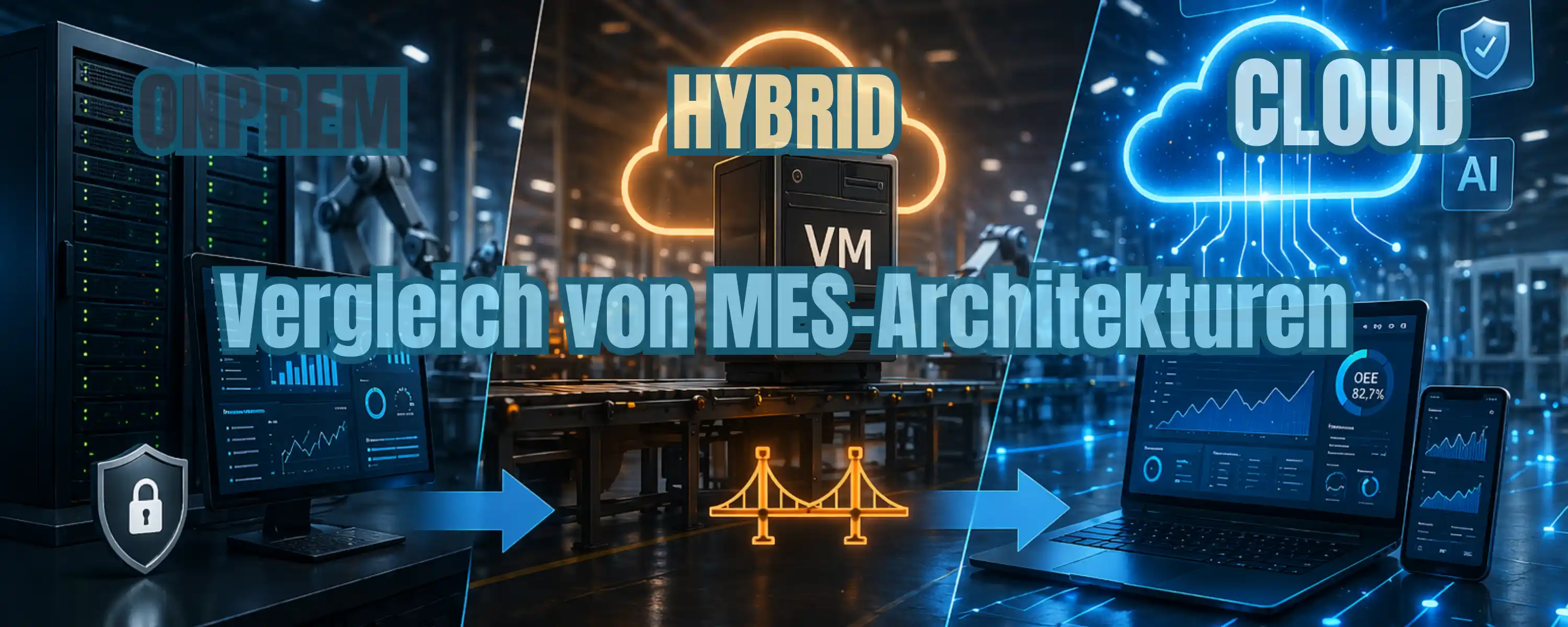
TL;DR: Every MES runs on one of three architectures: On-Premise (local servers, full control, 12–24 month rollout), Hybrid / Lift-&-Shift (legacy MES hosted on cloud VMs, 6–12 months), or Cloud-Native (SaaS, microservices, 2–8 weeks). The architecture you choose determines your cost model (CAPEX vs OPEX), your scaling speed (per-plant vs per-click), your IT burden (dedicated team vs zero maintenance), and whether you can add new plants in days or months. For 80 % of midsize discrete manufacturers, cloud-native is the right answer in 2026. The 20 % exception: fully validated GMP/GxP production or air-gapped defense environments.
Transparency note: SYMESTIC is a 100 % cloud-native MES, hosted on Microsoft Azure. We do not offer an on-premise option. This article compares all three architectures honestly — including where on-premise is the right choice.
Table of contents
An MES connects ERP-level planning (ISA-95 Level 4) with shop floor execution (Level 3). How that connection is built — where the software runs, how it scales, and who maintains it — defines the architecture.
1. On-Premise MES — The MES runs on servers in your own data center. Your IT team installs, maintains, patches, and backs up everything. All data stays on-site. Typical vendors: MPDV Hydra, Cronetwork (Industrie Informatik), GFOS. Rollout: 12–24 months. Cost model: CAPEX (license + hardware + consulting).
2. Hybrid MES (Lift & Shift) — An existing on-premise MES is moved to cloud-hosted virtual machines (e.g., Azure VMs). The software itself doesn't change — it's still monolithic. The hosting moves from your server room to a data center. This reduces local IT burden but doesn't unlock cloud-native benefits (auto-scaling, automatic updates, microservices). Rollout: 6–12 months. Cost model: mixed CAPEX/OPEX.
3. Cloud-Native MES — The MES is built for the cloud from day one. Microservices architecture. SaaS delivery. Automatic updates. No local infrastructure. Native APIs for ERP, IIoT, and analytics. Typical vendors: SYMESTIC, Tulip, 42Q. Rollout: 2–8 weeks. Cost model: OPEX (subscription per machine/plant).
| Criterion | On-Premise | Hybrid (Lift & Shift) | Cloud-Native |
|---|---|---|---|
| Hosting | Your data center | Cloud VM (Azure, AWS) | SaaS platform |
| Architecture | Monolithic | Virtualized monolith | Microservices |
| Cost model | CAPEX (license + HW + consulting) | Mixed CAPEX/OPEX | OPEX (subscription) |
| Year-1 cost (10 machines) | € 150 k–400 k+ | € 100 k–250 k | € 15 k–50 k |
| Implementation time | 12–24 months | 6–12 months | 2–8 weeks |
| Adding a new plant | New server, new license, new project | New VM, configuration | New database — done in days |
| Updates | Manual (IT-planned downtime) | Semi-automatic | Automatic (zero downtime) |
| IT staff required | Dedicated MES admin | Shared IT resource | Zero — vendor manages |
| IIoT / AI readiness | Retrofittable (costly) | Partial | Native (APIs, MQTT, OPC-UA) |
| ERP integration | Custom middleware | Same middleware, remotely | REST API + pre-built connectors |
| Data sovereignty | Full on-site control | Cloud provider region | Cloud provider region (EU available) |
| Best for | GMP/GxP, air-gapped, defense | Transition phase | Midsize discrete manufacturers |
| Your situation | Recommended architecture | Why |
|---|---|---|
| GMP/GxP-validated production, air-gapped network mandatory | On-Premise | Regulatory requirements mandate full local control. Cloud is not an option. |
| Existing on-prem MES, budget approved for infrastructure modernization only | Hybrid (Lift & Shift) | Buys time. Reduces local HW burden. But: plan the next step — this is a bridge, not a destination. |
| No MES yet. 1–6 plants. Discrete manufacturing. Want results in weeks. | Cloud-Native | No CAPEX, no IT project, no server room. Start on one line, scale to all plants. |
| Legacy MES is end-of-life. Full replacement needed. | Cloud-Native | Don't replace one monolith with another. Go cloud-native and eliminate the maintenance burden entirely. |
| Multi-plant enterprise, IT mandates SAP/Siemens ecosystem | On-Premise or Hybrid (corporate mandate) — but evaluate cloud for non-core plants | Corporate IT may require Opcenter or DELMIA. For satellite plants with less IT support, cloud-native is faster and cheaper. |
| Layer | What it does | SYMESTIC implementation |
|---|---|---|
| Shop floor connectivity | Reads machine signals via OPC-UA, MQTT, digital I/O | IXON IoT devices, DI gateways, OPC-UA Cloud Connector |
| Data ingestion & transformation | Timestamps, buffers, normalizes signals into a unified data model | Azure IoT Hub → SYMESTIC Data Transformation layer |
| Application layer (MES) | OEE, order tracking, alarms, SPC, SFM dashboards | Modular: MDE, BDE, Kennzahlen, Fertigungssteuerung, Alarme, Prozessdaten |
| Integration layer | Bidirectional ERP connectivity | REST API + SAP ABAP IDoc + InforCOM + Navision file interface |
| User layer | Dashboards, mobile app, shopfloor clients | Browser-based — unlimited users, unlimited dashboards, smartphone MES app |
Carcoustics — cloud-native at enterprise scale: 500+ machines across 7 countries (DE, PL, SK, CZ, MX, US, CN). IXON IoT devices → MQTT → Azure. Bidirectional SAP R3 integration via ABAP IDoc. Replaced a legacy on-premise solution in Poland and Haldensleben. All 7 plants connected within 6 months — not 24 months as the old system required. Results: 4 % fewer stoppages, 3 % higher output, 8 % better availability. Zero local server infrastructure at any plant.
Meleghy Automotive — 6-plant rollout: Started at Wilnsdorf. Scaled to Gera, Brandýs (CZ), Bernsbach, Reinsdorf, Miskolc (HU) within 6 months. Bidirectional SAP R3 + CASQ-it integration. SYMESTIC's modular architecture allowed Meleghy to scale independently — no SYMESTIC consulting needed for plants 3–6. Results: 10 % fewer stoppages, 7 % higher output, 5 % better availability.
| Phase | What happens | Duration |
|---|---|---|
| 1 | Pilot on one line. Connect 1–2 machines to the cloud MES. Compare data with the legacy system. Prove accuracy + speed. | 2–4 weeks |
| 2 | Expand within the pilot plant. Connect remaining machines. Build dashboards. Integrate ERP. Train key users. | 4–8 weeks |
| 3 | Parallel run. Run cloud MES alongside legacy system. Validate data consistency. Build confidence. | 4–8 weeks |
| 4 | Decommission legacy. Scale to next plant. Switch off old system. Replicate configuration to plant 2, 3, 4… | Ongoing |
The critical insight: you do not need to migrate all plants at once. A cloud-native MES allows **plant-by-plant rollout** with independent timelines. Carcoustics started with a POC at Haldensleben and reached all 7 plants within 6 months — each plant at its own pace.
What are the three MES architectures?
On-Premise (local servers, full control), Hybrid / Lift & Shift (legacy MES on cloud VMs), and Cloud-Native (SaaS, microservices, automatic updates). Each has different cost models, implementation timelines, and scaling characteristics.
Is a cloud MES secure enough for manufacturing?
Yes. Cloud-native MES platforms run on certified infrastructure (Azure, AWS) with enterprise-grade security (ISO 27001, SOC 2, encryption at rest and in transit). Data sovereignty is controlled by choosing the cloud region (EU data centers available). The IoT gateway uses outbound-only connections — no inbound ports opened.
How long does it take to implement a cloud MES?
First machines connected: 1–2 days. Full pilot plant with dashboards and ERP integration: 2–8 weeks. Multi-plant rollout: 3–6 months. Compare to on-premise: 12–24 months for a single plant.
Can I run cloud MES and on-premise MES in parallel?
Yes. Many manufacturers start the cloud MES on new lines or satellite plants while keeping the legacy on-premise system on validated lines. Over time, the cloud system expands and the legacy system is decommissioned.
What is the cost difference between on-premise and cloud MES?
On-premise: € 150 k–400 k+ in year 1 (license + hardware + consulting). Cloud-native: € 15 k–50 k in year 1 (subscription + onboarding). See our MES cost article for a detailed TCO breakdown.
The bottom line: MES architecture is not an IT decision — it is a business decision. On-premise gives control but costs time and money. Hybrid buys time but doesn't solve the scaling problem. Cloud-native delivers results in weeks, scales per click, and eliminates the IT burden entirely. For midsize discrete manufacturers with 1–6 plants, the architecture question in 2026 is answered: cloud-native — unless regulation explicitly prohibits it.
→ What is an MES? · → Cloud MES vs. On-Premise (Deep Dive) · → MES Costs · → MES Software Comparison · → IIoT · → OEE